


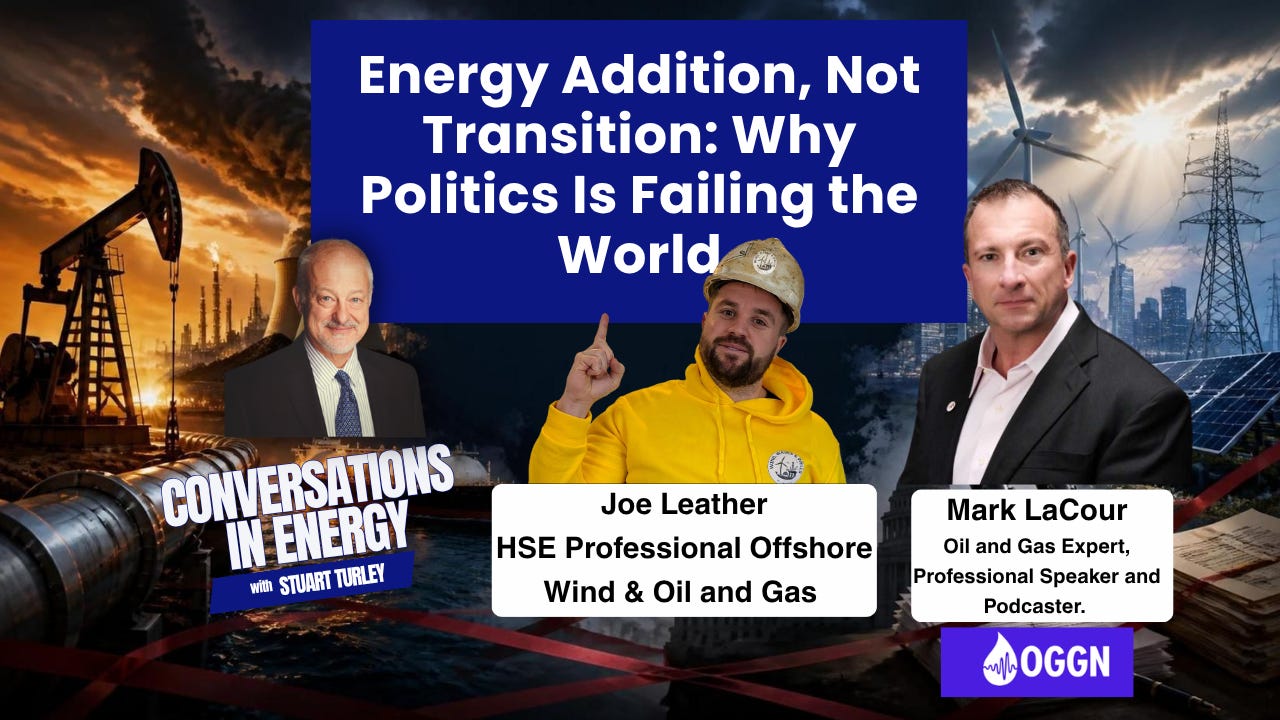
In a wide-ranging discussion that cuts through the noise of energy policy debates, three industry experts—Joe Leather (HSE Professional and Offshore Wind & Oil Podcast Host), Mark LaCour (Oil and Gas Expert and OGGN Editor-in-Chief), and Stu Turley (Energy News Beat Podcast Host)—tackle the contradictions, crises, and misconceptions shaping global energy markets.
From record-breaking diesel prices in Scotland to California’s paradoxical reliance on Russian crude despite abundant local reserves, this conversation exposes how political ideology disconnected from scientific reality is creating energy poverty, environmental hypocrisy, and geopolitical vulnerability.
Rather than debating whether the world needs an energy transition, these experts argue for an “energy addition”—acknowledging that global demand will only grow while infrastructure, grid capacity, and rational policy lag dangerously behind. Their discussion reveals uncomfortable truths about net-zero politics, the aging infrastructure crisis, and why the solutions being implemented often make problems worse, not better.
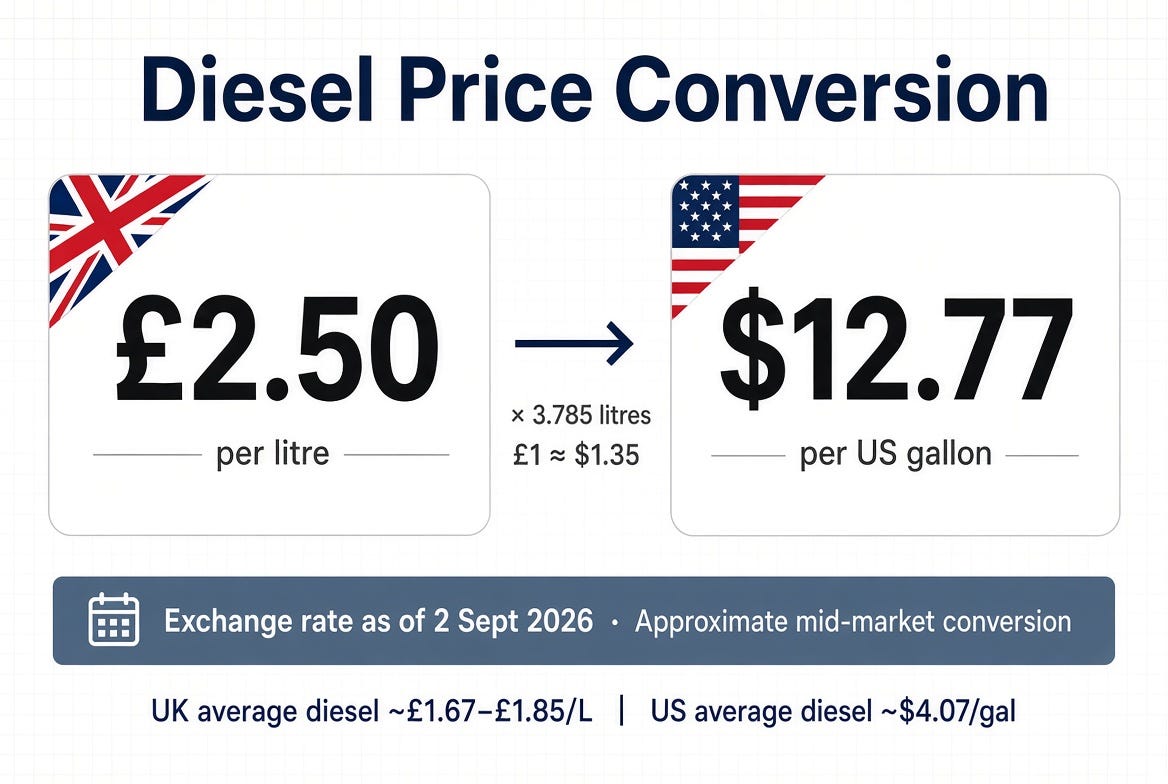
Joe just filled up his truck in Scotland for $12.77 per gallon! We cover how this is rolling to the U.S.
Yet amid the frustration, there’s cautious optimism: technology is advancing rapidly, younger generations view energy differently, and the world may finally be waking up to what pragmatism demands.
We had an absolute blast, and I even got a Yoda imitation in.
Check out Mark LaCour on The Great Oil Network OGGN
Check out Joe Leather on his Great podcast
https://windwavesandwells.com/
Add Free for our Energy News Beat Subscribers
This was a fun podcast, with lots of information packed into a 40-min talk.
1. Global Diesel Shortage Crisis
The hosts discuss the worldwide diesel shortage affecting prices dramatically—Joe paid £1.84 per liter (approximately $12.77/gallon) in Scotland. They explain this is caused by:
Refinery turnaround season in the US
Increased global demand for diesel
Limited crude oil supply due to Strait of Hormuz tensions
Refineries prioritizing jet fuel production over diesel due to higher profit margins
2. UK Refinery Capacity Collapse
The UK is losing refinery capacity due to political and net-zero policies. The hosts explain the paradox: the UK fleet switched from petrol to diesel vehicles, but environmental politics prevented refineries from retrofitting to produce more diesel, creating an oversupply of petrol and shortage of diesel.
3. Energy Politics vs. Reality
A central theme is how political decisions disconnected from scientific understanding are harming energy security:
California importing Russian crude while refusing to use its own local oil reserves
New York importing LNG from the Caribbean (sourced from Russia) instead of using abundant Pennsylvania natural gas
Germany’s failed renewable transition and subsequent energy poverty
4. Energy Transition vs. Energy Addition
The hosts argue the world needs an “energy addition” (more total energy), not a transition away from hydrocarbons. They emphasize:
Growing global energy demand
The need for a diversified energy mix
Renewable infrastructure inadequacy (grid capacity, decommissioning liability)
5. Infrastructure & Grid Challenges
UK and US electrical grids are aging and insufficient for renewable integration
Data centers (Microsoft, Amazon, Meta) are driving private infrastructure investment
Interconnection projects like Canada’s $6 billion line to New York are underperforming
6. Geopolitical Energy Security
Russia using energy as a weapon (Germany’s dependency on Russian gas)
Strait of Hormuz disruptions and alternative shipping routes
Ghost fleets (unseaworthy tankers) moving sanctioned Russian oil
The Jones Act limiting US domestic shipping efficiency
7. Environmental Hypocrisy
Examples of contradictory policies:
Burning wood pellets shipped from the US as “net-zero” fuel in the UK
Scottish wind farms requiring diesel generators to operate
Importing refined Russian oil while claiming environmental leadership
8. Technology & Innovation
AI discovering missed oil reserves in mature North Sea fields
Automation reducing rig crew sizes and improving safety
New small, efficient “teapot refineries” being built at crude sources
9. Political Polarization & Hope
The hosts discuss how extreme politics on both sides harm energy policy, but express cautious optimism that moderates are finding common ground and that “the world is healing.”
10. Generational Shift in Perception
Generation Alpha views the oil and gas industry positively—seeing it as innovative, well-paying, and cool—contrasting with their parents’ anti-oil sentiment.
The overarching message: Energy security requires pragmatic, science-based policy disconnected from political ideology.
At Energy News Beat, we Make Appendices Great Again.



Check out Joe Leather on his Great Podcast: https://windwavesandwells.com/
Check out the World’s Greatest Podcast Show Notes at EnergyNewsBeat.co or EnergyNewsBeat.com.

A shout-out to Steve Reese and the Reese Energy Consulting group for sponsoring the Podcast https://reseenergyconsulting.com/.
Data2 if you have any business systems, can you trust A? Well, they have the patent on validation. . https://data2.zoholandingpage.com/energy
And we have WellDatabase rolling, and we use their tools for the Energy News Beat weekly Rig Reports: https://welldatabase.com/
Also entering Sponsor Rey Trevino, Pecos Operating https://pecos.energy/
Tomorrow is Colin Grabow at the Cato Institute with David Blackmon. This will be a fun one.


